

The START Blog
Why is adult social care being left behind in the digital transformation?
We review the findings from the NHSX Technology innovation and digital skills review.
Background
Adult social care
England spends 28 billion pounds annually on Adult Social Care (ASC) [1]. ASC provides care and support to people who may need it due to age, illness, cognition, disability or other circumstances [2]. High-quality care enables people to live independent and fulfilling lives [3]. The government has committed to delivering high-quality, person-centred care, driven by technology [4]. NHSX (now part of NHS England) identified digital transformation as key for its vision of ASC [5]. In 2021, it commissioned The Technology Innovation and Digital Skills Review to understand the scaling of digital technology innovation and digital skills and capabilities.

This figure has been reproduced from The Kings Fund without any changes under the terms of the Creative Commons Attribution License.
So, what did the review find?
Views on digital technology
Across the sector, there was broad agreement on the benefits of technology, particularly in improving care quality, outcomes for people, and efficiency. Suppliers often highlighted cost savings, but providers were more cautious. For them, the clearer advantage was freeing up staff time to deliver more person-centred, higher-quality care.
Current use of digital technology
Basic digital tools like email and video calls were widely used, but uptake varied and the full potential remains untapped. Care workers used technology less than other ASC staff, and uptake was lowest among people with care needs and carers over 85. Awareness of care-specific technology was limited—higher among providers than carers or service users—though consumer tech was increasingly used in care.Importantly, there is strong willingness across the sector to embrace digital tools, with staff eager to build skills and organisations recognising technology’s role in the future of ASC. COVID-19 accelerated adoption, but inequalities remained, with nurses often given greater access than care workers.

What were the barriers?
Individuals
The report found that low digital confidence among staff and people with care needs was a major barrier. This stemmed from limited familiarity, few opportunities to use technology, poor awareness of available options, and anxiety about adopting new ways of working.
Organisations
Organisations saw budgets as a major barrier to investing in technology, especially as savings are unclear and benefits often appear downstream rather than to the investing organisation. Competing interests, limited leadership capacity, and a lack of sector-wide vision also contributed to inconsistent adoption and poorly connected systems. The diversity of ASC, with its many organisations and demands, further limits scalability and reduces confidence in investing.

Enablers
Enabling factors for groups within ASC included:
People with care needs and unpaid carers
• Better signposting and information regarding existing technology and future opportunities
• Hands-on support using technologies
• Being involved in the development processTechnology suppliers
• Clear vision from the government for policies, data standards and interoperability
• Financial support from the government to support smaller care providers to invest in technology
• Opportunities to communicate openly with the sector to discuss their needs and bridge the divide between industry and ASCCare providers
• More funding for investment in technology
• Upskilling the workforce in digital technology
• Greater support to review different technologies and decide what to implement
• Improved infrastructure, such as a reliable internet connection
• Support to improve change management processesLocal authorities
• Facilitating collaborations and improving their own digital infrastructure
Key recommendations
Involve end users in developing a sector-wide vision for digitising and ensure it’s specific to each of the above groups.
Develop co-produced standards and systems to support implementing technology.
Raise awareness and knowledge of digital technology in ASC.
Improve access to funding and procurement support for digital investments.
Define the digital skills needed by each group and provide targeted training and support.
What does this mean?
ASC faces many significant issues. Firstly, there continues to be a growing demand for care support and yet fewer people are receiving care [6] (Graph 2). This may be in part due to the funding gap. Data from NHS England (Graph 3) shows there is a 10-billion-pound shortfall in funding just to maintain the level of service delivered in 2010/2011 [7]
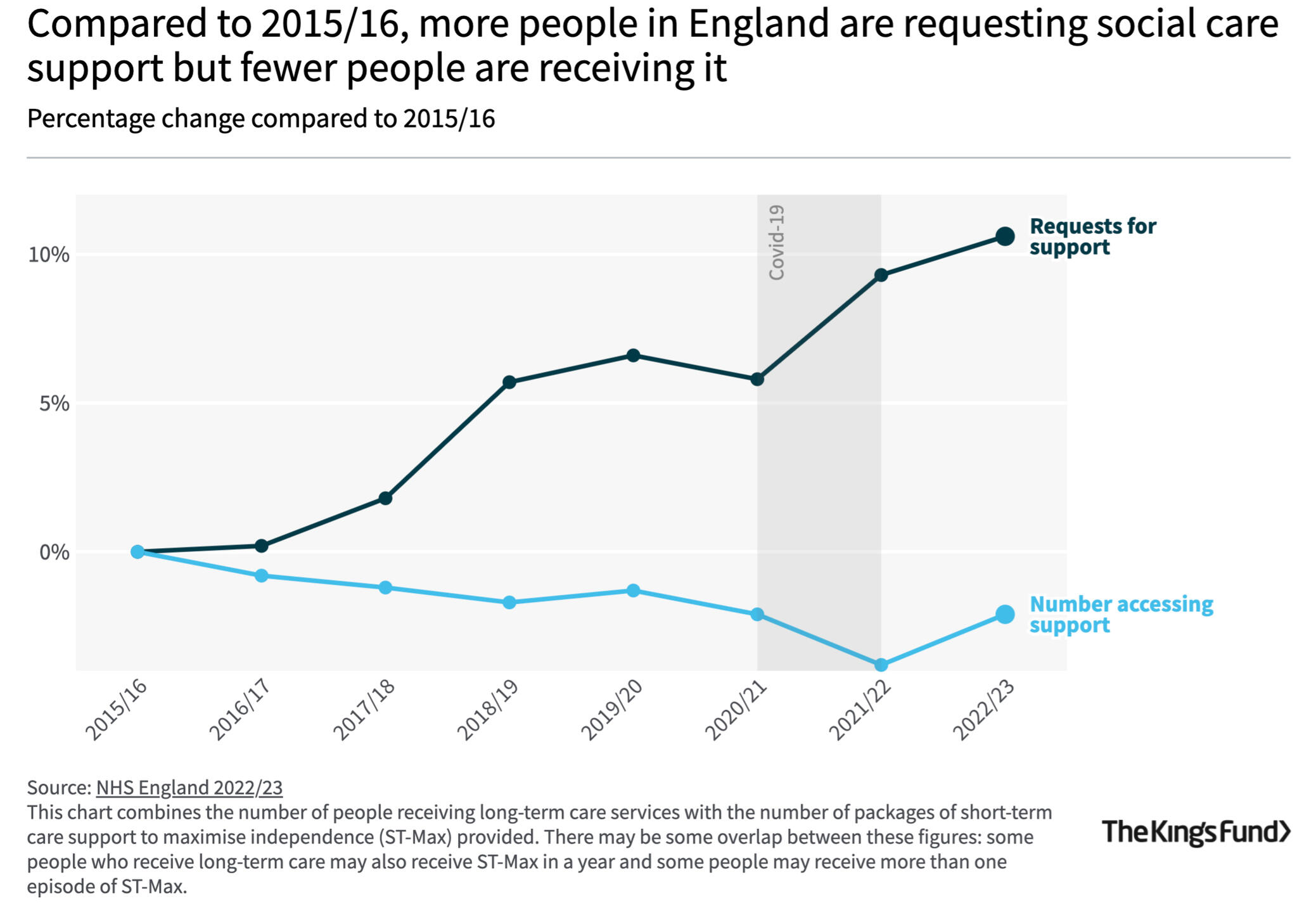
Graph 2: Demand Vs Delivery
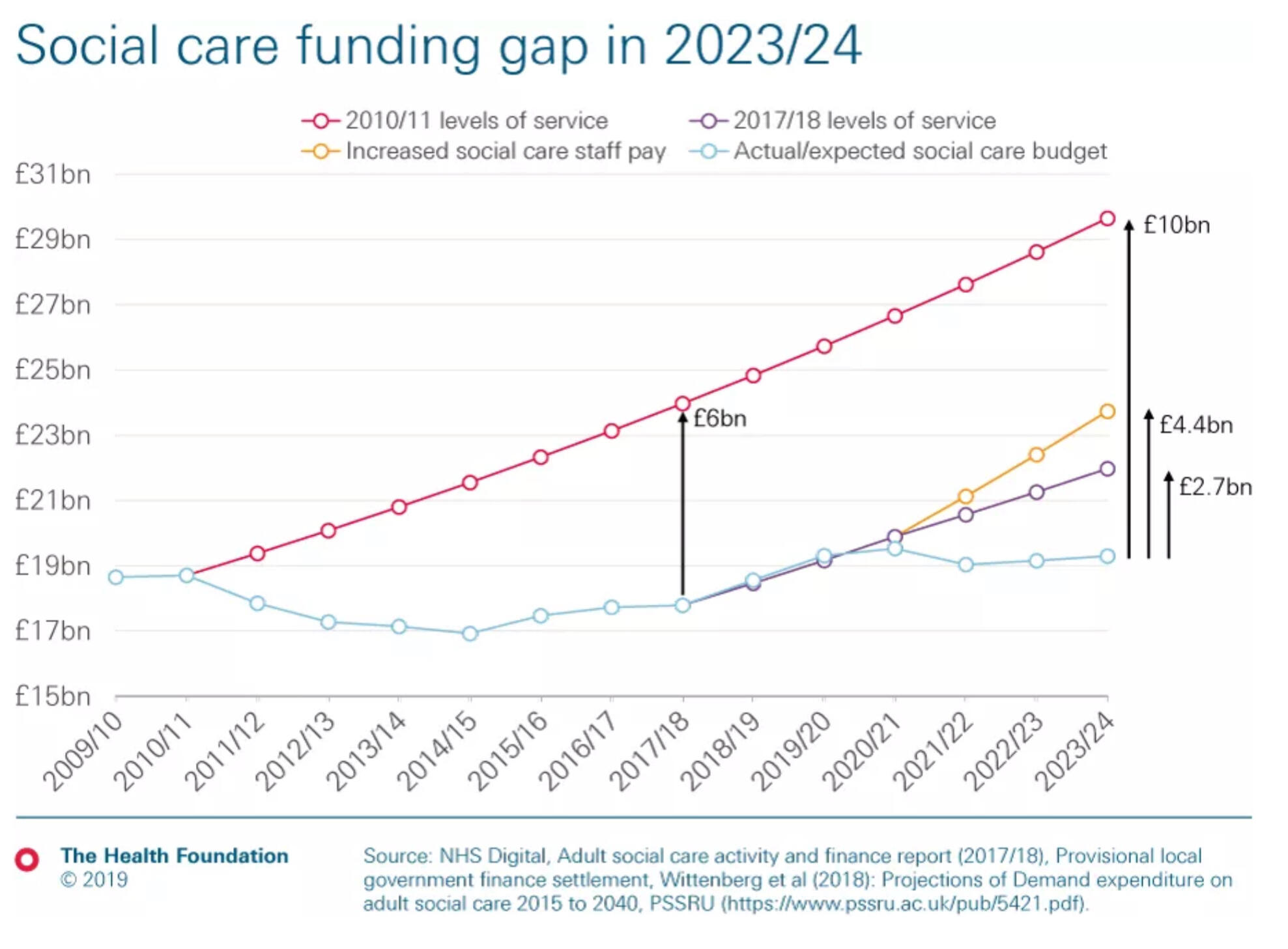
Graph 3: The funding gap
These figures have been reproduced from The Kings Fund and The Health Foundation without any changes under the terms of the Creative Commons Attribution License.
The digital transformation of ASC should drive efficiency and cost savings. Implementing digital solutions will enable more care to be delivered and for less money. But, as the NHSX review makes clear, this is going to take time, and more work is needed.
Using the START Tool
We have created this tool to help technology companies consider important aspects of their technological solutions to improve its success in uptake and implementation. Find out more below: